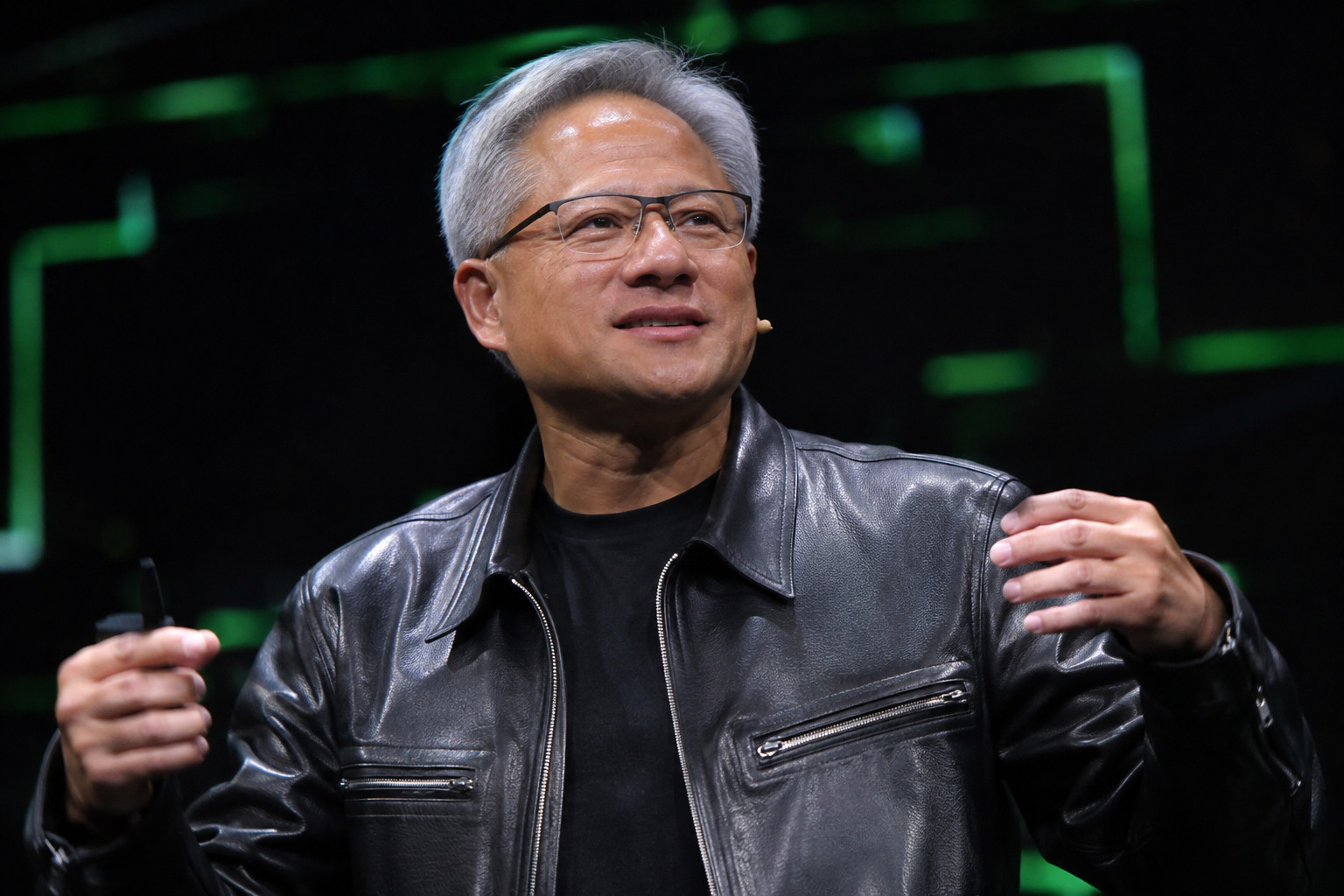
If Jensen Huang exits Nvidia, who could run the company next
Published Nov 12, 2026
Reports of a scandal around Nvidia's CEO have put a company with no clear succession plan under scrutiny. A look at the candidates, the odds, and what a leadership change would mean for developers.
Nvidia is the company most of the AI industry builds on, and for the first time in its modern history the question of who runs it is open. Reports of personal and security-related controversies surrounding CEO Jensen Huang have pushed prediction markets to price in real doubt about his tenure, and there is no obvious heir waiting in the wings. TechCrunch has published a deliberately informal shortlist of possible successors. It is a parlor game, but it highlights how unusual Nvidia's position is.
A founder-led company with no visible bench
Huang has run Nvidia since he co-founded it in 1993, and the company's identity is tightly bound to him. He has roughly 60 direct reports, a flat structure that keeps power concentrated in one person and makes it hard for any single lieutenant to look like the natural number two. Nvidia does not even have a chairman today, a seat that could become a landing spot if the board wants to retain Huang in some capacity while handing day-to-day operations to someone else.
That matters because Nvidia is no longer just a chipmaker. Its GPUs and the CUDA software stack sit underneath most large model training and a growing share of inference. A leadership vacuum, or a badly chosen successor, would ripple through cloud providers, startups, and every open-source project whose performance depends on Nvidia hardware.
The names being floated
The candidate list splits into outsiders, rivals, and insiders.
- Lisa Su, AMD. She runs Nvidia's most credible competitor. Leaving would mean abandoning a company that benefits from every distracted day at Nvidia, so the move looks unlikely.
- Eric Schmidt. The former Google chief has led a major company, chaired a national AI security commission, and now runs a rocket company. His own past controversies would complicate any board approval.
- Lip-Bu Tan, Intel. He knows semiconductors, and Intel's recent guidance warning and stock slide could make a move tempting.
- Bret Taylor. A veteran of Google Maps, Facebook, Salesforce, and OpenAI's board, he is the "steady adult in the room" pick.
- Ian Buck. The Nvidia vice president who helped create CUDA is the builder candidate. Analysts and former employees have mentioned him, and betting markets give him a middling chance.
- Andrew Bell. A 25-year company veteran leading hardware engineering, with the chip pedigree that some argue a CFO lacks. CFO Colette Kress is the insider most often named, though some analysts doubt she is a visionary pick.
- Lori Huang. The wild card: Huang's wife, a former chip engineer who has worked alongside him since before Nvidia existed.
Why developers should care
CUDA is the clearest reason this is more than corporate gossip. Its dominance is the moat that has kept competing accelerators, including AMD's ROCm-based stack and various open-source efforts, in a perpetual catch-up position. A successor who is an engineer, like Buck, would probably protect that platform strategy. An outsider from finance or consulting could shift priorities around licensing, pricing, or how open the ecosystem remains.
There is also a competitive angle. Any period of internal turmoil gives rivals and hyperscalers building their own silicon more room to win customers. Projects pushing portable compute layers, such as those that let models run across vendors without CUDA lock-in, would gain a stronger argument.
What to watch next
The immediate signals are whether the board names an interim leader, whether a chairman role is created, and whether Huang stays involved in some form. Prediction markets and analyst commentary will keep moving as new reporting lands, and much of what is circulating is still allegation rather than established fact.
Whatever the outcome, the episode exposes a real structural risk: one of the most strategically important companies in technology has leaned on a single founder with no public successor. How the board resolves that will shape the AI hardware market well beyond Nvidia's own stock price.
Image: AI-generated illustration of Jensen Huang.
Original reporting: TechCrunch